
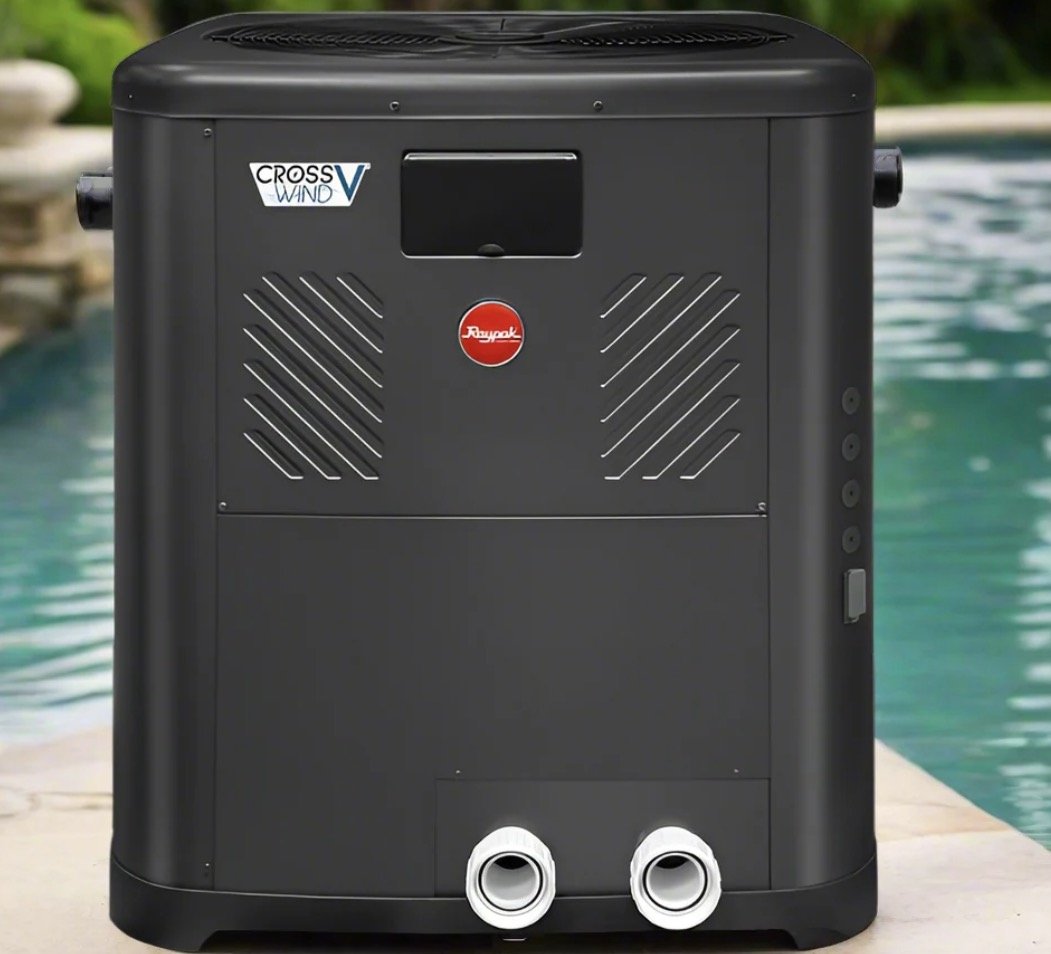
Heat pump pool heaters are often sold on the promise of lower operating costs than gas — and there's real substance behind that, but also real nuance that tends to get flattened into marketing bullet points. Raypak's Crosswind and Crosswind V lines are two of the more common heat pumps you'll see quoted for North Texas installations, so it's worth understanding what the company's own specifications actually say before assuming a specific dollar-figure outcome.
What a Heat Pump Actually Does
A gas heater burns fuel to generate heat directly. A resistance electric heater generates heat by running electricity through a heating element — effectively a giant version of the coil in a space heater. A heat pump does neither. It uses a refrigeration cycle to pull existing heat out of the outside air and transfer it into your pool water, the same basic principle an air conditioner uses in reverse. Moving heat that already exists in the air takes meaningfully less energy than generating heat from scratch, which is the entire basis for a heat pump's efficiency advantage.
Inverter Technology in Raypak's Crosswind Line
Raypak's Crosswind pool heaters use inverter technology, which lets the unit vary its heating output instead of running at one fixed capacity. According to Raypak, the Crosswind runs at full capacity when it first starts up, to bring a cold pool up to temperature as quickly as possible. Once it reaches your target temperature, it automatically shifts into a lower-capacity maintenance mode — modulating its output in small increments to hold that temperature rather than cycling fully on and off. Raypak states this approach improves energy efficiency and produces quieter, steadier operation compared to a heater that only knows "on" or "off."
COP, in Plain English
You'll see "COP" attached to every heat pump spec sheet, and it's worth actually understanding rather than skimming past. COP stands for Coefficient of Performance — the ratio of heat energy the unit delivers to the electrical energy it consumes. Raypak's published specifications list COP ratings of 5.3 to 6.1 across its current Crosswind and Crosswind V models, depending on the specific unit. In practical terms, a COP of 6 means the heat pump is rated to move roughly six units of heat energy into your pool for every one unit of electricity it uses — which is dramatically more efficient than a resistance electric heater, which effectively converts electricity to heat at close to a 1-to-1 ratio.
Why Efficiency Changes With Conditions
Here's the part that matters most and gets glossed over the most: a COP rating is measured under specific test conditions, not a promise about how the unit will perform in your backyard on every day of the year. A heat pump pulls heat from outside air, so its real-world efficiency shifts with outdoor temperature, humidity, your target water temperature, how big the gap is between current and desired water temperature, and how long the unit runs. A heat pump working to maintain 82°F water on a mild 75°F day is operating under very different conditions than one trying to bring a cold pool up to temperature on a cool morning — and the published COP figure reflects one specific scenario, not every scenario you'll encounter across a full swim season.
Maintaining Temperature vs. Rapidly Heating a Cold Pool
This distinction matters more than most homeowners expect. Heat pumps are generally well-suited to maintaining a steady temperature over time — running efficiently in that lower-capacity mode Raypak describes for the Crosswind. They're less well-suited to rapidly heating a pool from cold, which is where gas heaters typically have the edge on speed. If your priority is "heat the pool fast for a weekend party," a heat pump alone may not deliver the timeline you're picturing; if your priority is "keep the pool at a comfortable temperature across the season without babysitting it," a heat pump's operating profile fits that use case well.
Why We Won't Give You a Guaranteed Savings Percentage
Plenty of marketing will tell you a heat pump saves "up to" some specific percentage compared to gas or resistance electric heating. We're not going to do that here, because it isn't honest without knowing your specific pool size, your target temperature, your local electricity rates, your desired swim season length, and your climate exposure. What we can tell you accurately is Raypak's published COP ratings and how the underlying technology works — and those numbers are strong enough on their own that you don't need an inflated marketing claim layered on top to make the case.
Is a Raypak Heat Pump Right for a North Texas Pool?
Heat pumps generally perform well across most of the outdoor temperature range North Texas sees during a typical swim season. Where they lose ground is in colder conditions — efficiency drops as outdoor air temperature drops, which matters most if you're hoping to extend swimming deep into winter rather than through a standard spring-to-fall season. For a lot of Prosper, Celina, Frisco, and McKinney homeowners looking to maintain comfortable water temperature through the bulk of the year without the faster heat-up speed (and higher gas usage) of a gas heater, a heat pump is a reasonable fit — it's a conversation worth having about your specific goals rather than a decision to make off a marketing percentage.
Frequently Asked Questions
How does a heat pump pool heater save money compared to a resistance electric heater?+
A heat pump doesn't generate heat directly the way a resistance electric heater does — it moves existing heat from the outside air into your pool water using a refrigeration cycle, similar in concept to how an air conditioner or refrigerator works in reverse. Moving heat takes far less electricity than generating it, which is the entire basis for a heat pump's efficiency advantage.
What does COP mean?+
COP stands for Coefficient of Performance — a ratio of heat output to electrical energy input. Raypak publishes COP ratings for its Crosswind and Crosswind V models in the 5.3 to 6.1 range depending on the specific model, meaning the unit is rated to move roughly five to six units of heat energy into your pool for every one unit of electrical energy it consumes, under the conditions used for that test.
Will a Raypak heat pump guarantee a specific percentage savings on my electric bill?+
No, and you should be skeptical of anyone who tells you otherwise. COP figures are measured under specific test conditions. Your actual real-world efficiency depends on outdoor air temperature, desired water temperature, how long the pump runs, your pool's size and exposure, and how well the rest of your equipment is maintained. Raypak publishes the ratings; nobody can honestly convert that into a guaranteed dollar figure for your specific pool without knowing all of those variables.
Does a heat pump heat a pool as fast as a gas heater?+
Generally, no — gas heaters typically raise water temperature faster than heat pumps, which is one of the core tradeoffs between the two technologies. We cover this comparison in more depth in a separate article on heat pumps versus gas heaters.
What is inverter technology and how does it apply to Raypak's Crosswind?+
Inverter technology lets the heat pump vary its output rather than running at one fixed capacity. According to Raypak, the Crosswind runs at full capacity to heat a cold pool quickly at startup, then automatically shifts into a lower-capacity maintenance mode once it reaches your target temperature — modulating output in small increments to hold that temperature efficiently rather than cycling fully on and off.
Is a Raypak heat pump a good fit for North Texas?+
Heat pumps generally perform best in the outdoor temperature ranges common through most of a North Texas swim season — they lose efficiency as outdoor air temperatures drop toward freezing, which matters less here than in colder climates but is still worth factoring in if you're hoping to extend swimming into the coldest weeks of winter.