
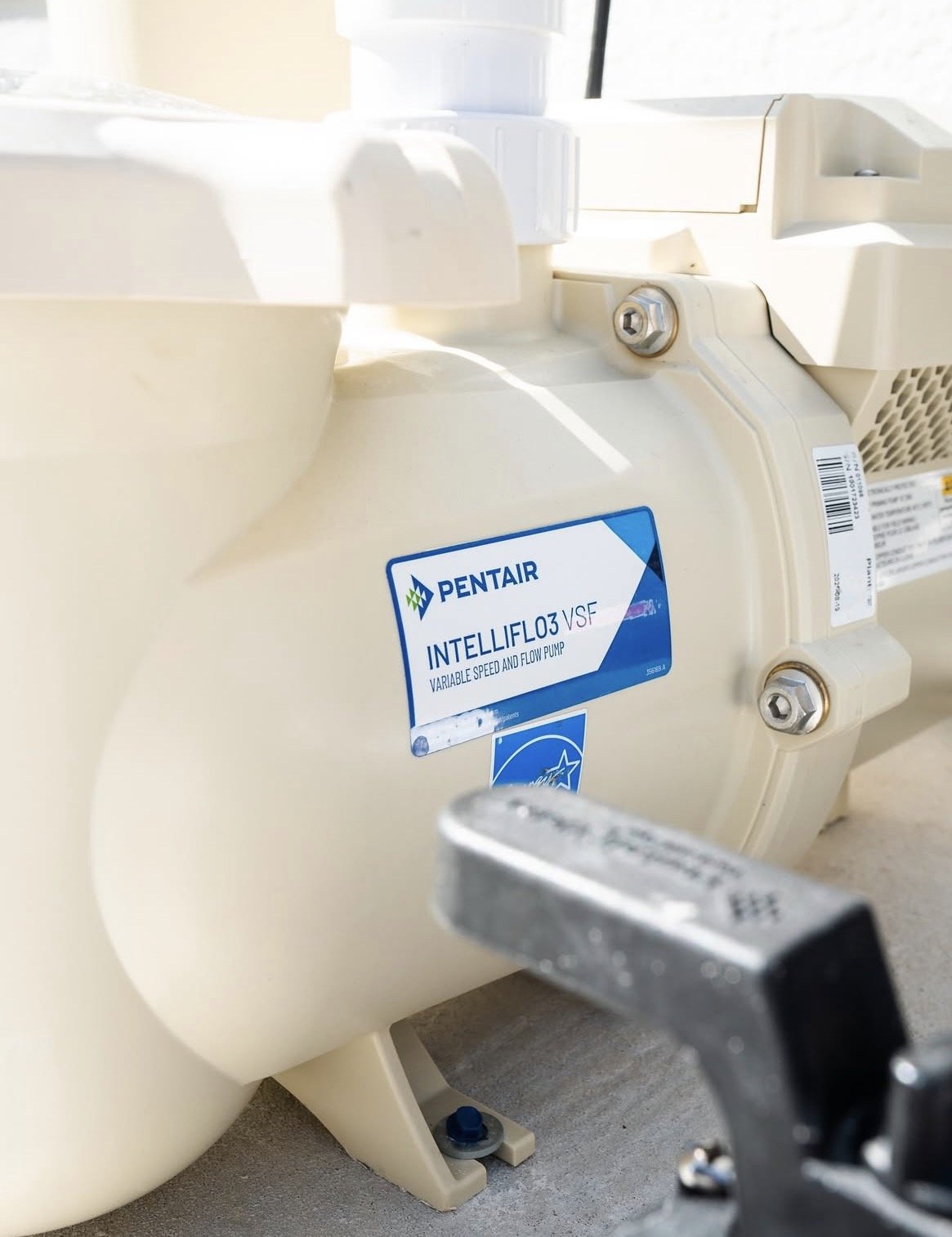
A pool pump isn't a glamorous purchase, but it's one of the pieces of equipment that most directly affects both your water quality and your electric bill. The Pentair IntelliFlo3 VSF is currently Pentair's top-tier variable speed pump, and it comes up constantly in homeowner research for good reason — it's a meaningfully different piece of equipment than the single-speed pumps still running in a lot of North Texas backyards. This guide walks through what it is, how it works, and what to actually weigh before replacing your current pump.
What the IntelliFlo3 VSF Is
The IntelliFlo3 VSF is Pentair's current variable speed and flow pool pump, built around three things: a motor that can run at a range of speeds rather than one fixed speed, built-in flow sensing technology that doesn't require a separate physical flow sensor, and Wi-Fi connectivity that ties into the Pentair Pool app. It's available in 1.5 HP and 3.0 HP versions, and it's ENERGY STAR certified.
What "Variable Speed and Flow" Actually Means
A traditional single-speed pump runs at one speed, full blast, whenever it's on — which is often far more flow than your pool actually needs for filtration at any given moment. A variable speed pump can run at different speeds depending on what's actually required. "Variable speed and flow" goes a step further: instead of just letting you manually pick a speed, the pump is designed to actively maintain a target flow rate and adjust its speed to hit that target as conditions change.
How Sensorless Flow Control Works
This is the part that trips people up, so it's worth explaining plainly. Most flow-sensing systems require a physical sensor installed in the plumbing to measure water flow directly. Pentair's sensorless flow technology skips that separate sensor — instead, the pump itself monitors internal conditions (like motor load) to infer what's happening with flow through the system. Pentair's own example is a good one: as your filter accumulates dirt and debris between cleanings, it creates more resistance in the plumbing. The pump detects that increased resistance and speeds up automatically to maintain the flow rate you've set, rather than just quietly filtering less water as your filter gets dirtier.
Why Variable Speed Can Reduce Energy Consumption
The energy logic is straightforward: pump energy use scales dramatically with speed, not linearly. Running a pump at half speed doesn't use half the energy — it typically uses much less than half, because of how centrifugal pump physics work. A single-speed pump has no choice but to run at full speed any time it's on. A variable speed pump can run at a lower speed for routine filtration most of the day and only ramp up when it actually needs to, which is where the bulk of the potential savings comes from.
What Pentair's "Up to 90% Energy Savings" Claim Actually Means
This is the number that gets repeated everywhere, and it deserves real scrutiny rather than blind repetition. Pentair's own published specifications tie that 90% figure to a specific comparison: a variable speed pump versus a single-speed pump running 12 hours a day at an average rate of $0.16 per kWh, in a 20,000-gallon pool, under a defined filtration flow scenario. Pentair explicitly states that actual savings vary based on your local utility rates, your pool's size, how long you run the pump, the pump's horsepower and RPM, your plumbing size and length, the specific pump model, and other hydraulic factors.
None of that means the savings potential isn't real — the underlying physics of variable speed pumping are well established, and most homeowners moving off an old single-speed pump do see a meaningful drop in pump-related electricity use. But "up to 90%" is a best-case, test-condition number, not a promise about your specific electric bill. Anyone quoting you an exact dollar savings figure without knowing your pool's size, your local electricity rate, and your current pump's runtime is guessing.
How the Pentair Pool App Works
The IntelliFlo3 connects to the Pentair Pool app over Wi-Fi or Bluetooth, which is what unlocks most of the pump's "smart" functionality. Through the app you can set up the pump, monitor how it's running, adjust the flow rate, and receive alerts if something needs attention — all from your phone rather than walking out to the equipment pad.
Remote Monitoring
Beyond your own access, the app also supports granting remote monitoring access to a local pool professional. Once you've set the pump up in the app, you can go into settings, select remote monitoring, and invite a pool professional to keep an eye on performance — useful if you want a second set of eyes on your equipment without a scheduled visit every time something seems slightly off.
Scheduling and Programming
According to Pentair's support documentation, the pump operates in three modes: manual, timer, and schedule. Out of the box, it defaults to a 24-hour schedule running at 30 gallons per minute, and you can store up to eight separate programs — useful if your filtration needs shift seasonally or if you want different settings for water features versus standard filtration.
Noise
Pentair markets the IntelliFlo3 as quieter than single-speed pumps, which is consistent with how variable speed pumps generally behave — most of the time, they're not running at the same high RPM a single-speed pump is stuck at continuously. Pentair doesn't publish a specific decibel comparison in its consumer materials, so if a quiet backyard is a priority for you, it's worth asking your installer for a firsthand demonstration.
ENERGY STAR Certification
The IntelliFlo3 is ENERGY STAR certified and, per Pentair, compliant with the Department of Energy's current standards for variable speed pumps. Each model also carries a Weighted Energy Factor (WEF) rating — a standardized efficiency metric where a higher number generally indicates better efficiency — which varies between the 1.5 HP and 3.0 HP versions.
Available Horsepower Options
The IntelliFlo3 VSF comes in two sizes: 1.5 HP and 3.0 HP. They differ not just in power but in port sizing and electrical requirements, so the right choice depends on your pool's plumbing and volume — not just matching the horsepower of whatever pump you're replacing.
What to Consider Before Replacing Your Current Pump
A few things worth thinking through before committing to an upgrade:
- Your current pump's condition. If it's failing or already needs major repair, replacement math looks different than if it's simply older but functional.
- Your plumbing. Port sizes and available electrical service (115V vs. 208-230V, depending on horsepower) affect installation complexity and cost.
- What you're actually trying to solve. Lower energy bills, quieter operation, remote monitoring, and entry-level automation are different motivations that might point toward different equipment choices.
- Water features. If you're running fountains, spillways, or other features with significant flow demands, sizing needs to account for that alongside standard filtration.
When an IntelliFlo3 Upgrade Makes Sense
In our experience, the clearest cases for upgrading are: an aging single-speed pump that's approaching the end of its life anyway, noticeably high electricity costs traceable to long pump runtimes, a desire for basic remote monitoring or entry-level automation without installing a full separate system, or simply replacing an older-generation IntelliFlo pump that Pentair no longer manufactures. If none of those apply and your current pump is running fine, there's no urgency — but if you're already facing a replacement decision, it's worth understanding what a variable speed and flow pump changes before defaulting to another single-speed unit.
Frequently Asked Questions
What is the Pentair IntelliFlo3 VSF pump?+
It's Pentair's current flagship variable speed and flow pool pump — the pump the company positions as the successor to its long-running original IntelliFlo line. It combines a variable-speed motor with what Pentair calls sensorless flow control, plus Wi-Fi connectivity through the Pentair Pool app.
How much energy can the IntelliFlo3 actually save?+
Pentair advertises savings of up to 90%, but that figure comes with specific conditions attached: it's based on comparing the pump to a single-speed pump running 12 hours a day at an average electricity rate of $0.16 per kWh in a 20,000-gallon pool, under a particular flow and filtration scenario. Pentair states directly that actual savings vary based on your local utility rates, pool size, runtime, horsepower, RPM, plumbing, pump model, and other hydraulic factors. Treat the 90% figure as a best-case reference point, not a guarantee for your specific pool.
Do I need a separate automation system to use the IntelliFlo3's smart features?+
Not necessarily for basic scheduling and monitoring — the pump itself connects to the Pentair Pool app for setup, monitoring, and control. If you want to control more than two additional pieces of equipment, or want a more full-featured system, you'd move up to a dedicated Pentair automation system like IntelliCenter. We cover this distinction in more depth in our IntelliFlo3 automation article.
Is the IntelliFlo3 noisy?+
Pentair markets it as quieter than single-speed pumps at comparable distances, which tracks with how variable speed pumps generally operate — they don't need to run at full single-speed RPM most of the time. Pentair doesn't publish a specific decibel figure for direct comparison, so if noise is a major concern for your setup, ask your installer for a demonstration or reference unit.
What horsepower size do I need?+
The IntelliFlo3 is available in 1.5 HP and 3.0 HP versions, each with different port sizing and electrical requirements. The right size depends on your pool's volume, plumbing, and any water features you're running — this is a sizing decision worth having a professional confirm rather than guessing based on your old pump's horsepower alone.
Can I control the pump from my phone?+
Yes. The pump connects via Wi-Fi or Bluetooth to the Pentair Pool app, which lets you monitor performance, adjust flow rate, and receive alerts from anywhere. You can also grant a local pool professional remote monitoring access through the app if you want a professional keeping an eye on performance.
Is the IntelliFlo3 ENERGY STAR certified?+
Yes — Pentair states the IntelliFlo3 is ENERGY STAR certified and compliant with the Department of Energy's current standards for variable speed pumps.
How many programs can the pump run?+
According to Pentair's support documentation, the IntelliFlo3 supports up to eight different programs across three modes — manual, timer, and schedule — with a default 24-hour schedule running at 30 gallons per minute out of the box.